Showing posts with label Did you know?. Show all posts

1.31.2008

Did you know? Ragged-tooth shark


The most obvious distinguishing feature of the spotted ragged-tooth shark (Carcharias taurus, also known as the grey nurseshark or sandtiger) must be its impressive set of teeth. There are around 44-48 upper teeth and 41-46 lower teeth. The shark is constantly replacing its older teeth with new ones. A ragged-tooth shark can go through around 30 000 teeth in its lifetime.

These needle-like teeth are used to catch a diet of bony fish, squid, eels, rays and crustaceans.

Earth-Touch has recently been filming a group of pregnant ragged-tooth sharks at Sodwana Bay, part of the Isimangaliso Wetland Park on the Indian Ocean coast of South Africa. Links to the video clips are found below.

These sharks are very social animals and more often than not they are seen quietly floating around in large groups. In spite of its fierce appearance the ragged-tooth shark is not aggressive at all unless provoked. In fact during the gestation period the female shark avoids encounters with humans.

This population has a migratory breeding pattern which starts with the movement of sardine shoals from South Africa’s Eastern Cape coast northwards to the KwaZulu-Natal coast. Here the sharks mate, then the females move northwards again to the Sodwana Bay area for part of the gestation period before returning to the Eastern Cape to give birth.

Ragged-tooth sharks are ovoviviparous reproducers. What this means is that the female produces eggs which, when fertilized, hatch inside her. These eggs have no placental connection to the female. The largest embryo develops teeth and feeds off the smaller embryos during the gestation period. The pup that survives to be born typically measures in at around 100cm in length. Only one pup is born from each of the two uteri.

Unsurprisingly, ragged-tooth sharks have no natural predators to speak of. Like most sharks, they do not have particularly good eyesight. They tend to rely much more on their sixth sense, which is electroreception. Small, sensitive pores located under their noses allow the shark to detect any small electric current in the water.

Another interesting feature of this species is that it gulps air at the surface to improve its buoyancy.

See pregnant “raggies” in the clips:

Pregnant sharks hug the reef

Sharks relax around boulders

Sharks in a surging sea

Sharks lounge at the reef

Sharks follow a path

Image © Earth-Touch 2008

1.28.2008

Did you know? Oxpeckers on the back of mammals

Oxpeckers are often seen on the backs of animals like hippo, buffalo and kudu. They feed off parasites such as ticks and bloodsucking flies that live on the mammal’s skin.

These birds have a mutual relationship with mammals, removing parasites in exchange for observing the surroundings from an aerial viewpoint and alerting them of danger.

However, the significance of their impact on the mass of parasites is often questioned.

Mammals often have to rid themselves of excess parasites through other means such as grooming, bathing in mud, rolling in sand or rubbing their bodies on nearby trees.

Nevertheless oxpeckers are adapted to remain balanced and move about on the skin or hair of their hosts as they feed.

These birds are not found on elephants, perhaps because their skin differs from that of other mammals and they do not have many ticks. Oxpeckers are a nuisance to elephants, which are often seen swatting these birds off them with their tail, trunk or ears.

Oxpeckers are not the only birds that frequent the backs of mammals. Another is the cattle egret, which eats prey disturbed by the mammal and sometimes eats parasites on the mammal.

See birds on the backs of various mammals in the Earth-Touch clips, Hippo bull shows his dominance, Frog chorus, Sea of black buffalo and Silent sentinels.

Image of red-billed oxpecker on a hippo's back © Earth-Touch 2008

1.24.2008

Did you know? Clownfish

Clownfish, their vibrant colour making them distinctly visible, live amongst sea anemones, immune to their stinging tentacles.

A layer of mucus on their body is their protection from these stings, which are fatal for other fish species.

The clownfish is a highly territorial fish, fiercely guarding its anemone home from predators and rivals.


Anemones are believed to avoid stinging fish that have gained shelter for a while, so they do sting some new clownfish.

See two twobar clownfish (Amphiprion allardi) swimming in and out of their anemone home in the Earth-Touch clip, Fish take refuge from ocean surge

Image © Earth-Touch 2008

1.23.2008

Did you know? Indian Ocean bottlenose dolphins

One of the most common species sighted off the eastern coast of Southern Africa is the Indian Ocean bottlenose dolphin (Tursiops aduncus), which lives in pods of sometimes 100 or more animals.

Like whales, dolphins are cetaceans whose ancestors were land-dwelling animals.

The Indian Ocean bottlenose dolphin has been recognised as a species separate from the common bottlenose dolphin (Tursiops truncatus) only in the past few years.

Because these dolphins favour in-shore waters, their long-term survival is threatened by human activity, including the setting of shark nets to protect swimming beaches, in which the dolphins are sometimes caught.

In the clip
Dolphin encounter, Earth-Touch crew member Graeme Duane swims amongst a pod of about 50 bottlenose dolphins off Techobanini Bay, southern Mozambique.

Image © Earth-Touch 2008

1.22.2008

Did you know? Tsessebe

Tsessebe (Damaliscus lunatus) are highly territorial antelope. Males regularly patrol and mark their range.

They secrete a sticky fluid from their preorbital glands onto grass stems, or rub their faces and horns on anthills and sandy mounds.

They also have glands on their front feet and will paw the ground to mark it with their scent.

Tsessebe are often seen standing on mounds, showing their presence to deter potential trespassers.

See this grazer in the Earth-Touch clip,
Dominant tsessebe chases challenger.

Image © Earth-Touch 2008

1.21.2008

Did you know? Tamandua

There are two species of tamandua, the northern (Tamandua mexicana) and the southern (Tamandua tetradactyla).

These anteaters are found in Central and South America.

The northern tamandua has a distinct “v” marking on its back which occurs only in some southern tamanduas.

The animals have four digits on their front feet and five on their hind feet. They walk on the outer edge of their forepaws so as not to cut themselves with their sharp claws.

Tamanduas spend most of their time in trees and feed mainly on arboreal termites and ants. They hunt these by ripping open nests with their strong limbs, then sticking their long snout into the nest and using their long, sticky tongue to grab the insects. As they have no teeth, tamanduas digest their food with their powerful gizzard, an internal organ that grinds up food.

See a tamandua found in the Pantanal region of Brazil in the
Earth-Touch expedition footage, Anteater takes cover in tree roots.

Image © Earth-Touch 2008

1.15.2008

The marula tree

This tree, Sclerocarya birrea, is found in Botswana, Zimbabwe, South Africa, Namibia and Swaziland, amongst other African countries. It bears small, round fruit, yellow when ripe and green when unripe, which can be harvested from January to March.

There are countless myths and legends about this tree.

It is a fact, however, that marula wood is traditionally used for carving pestles and mortars and for making floors, boxes, tool handles, canoes, furniture, tools, yokes, plates, bowls, beehives, toys, ornaments and drums.

The Northern Sotho people of South Africa have a myth that the marula tree was given to the people by the spirits and is sacred. Often during the First Fruits ceremony, a goat or black bull is slaughtered at a selected marula tree, where marula beer in a clay pot is offered to the ancestors.

To the Zulu people it’s also known as the marriage tree because it is a symbol of fertility and used in cleansing rituals before marriage.

The bark of the tree has medicinal properties. It can be used in the treatment of dysentery and diarrhoea and as a malaria prophylactic. It also contains antihistamines and is used for cleansing when the bark is steeped in boiling water and the steam inhaled.

Amongst the Venda a woman who wants a baby boy may take a mixture made from the bark of the male tree, or if she hopes for a girl, from the female tree. If the child born is not of the desired sex, then it is said to be very special in being able to disregard the spirits. Another traditional practice is that newborn girls and their mothers are washed in water heated on a fire of marula twigs so that the baby may be fertile.

In Swaziland, as the women pick up marula fruit from the ground to prepare for the Xikuha Marula Festival, they look for worms in the fruit. Worms signify that the planting season is ready to start. As they move from home to home in celebration of the marula, they believe that it chases away the worms from the fields. Some scientific evidence does back this myth – as the fruit on the ground ripens, worms are attracted to the sugar in the fruit, and this alerts the women to the risk of worms for their crops. They then spread the marula fruit around the area and the worms do disappear.

The leaves of the marula are used as dressings for burns and wounds, as a relish in food and to relieve heartburn.

The fruit is eaten whole by people and a variety of animals. It is juicy and aromatic and the size of a small plum. It may be eaten fresh and the flesh has a high vitamin C content. It may also be cooked to produce jam and juices.

The kernels, rich in oil and protein, are ground up to make porridge, condiments and cereals and the oil is used as a skin cosmetic.

An alcoholic beverage called mampoer is produced from overripe marula fruit.

There are rumours that the fruit intoxicates animals. Elephants and baboons enjoy the fruit, but for the elephant to get drunk it would need to eat unusual amounts of already fermenting fruit, and since these huge animals drink up to 160 litres (338 pints) of water a day, it will dilute the marula.

Go to the following Earth-Touch clips for more on the marula tree:

Pathway to another marula,

A young elephant is put in its place,

and Marula magic captivates elephants.

Image © Earth-Touch 2008

Fishy facts

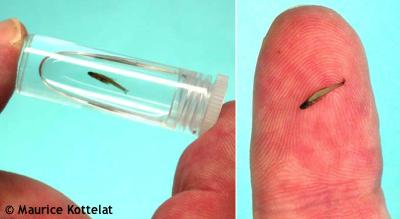
The world’s smallest fish is the Paedocypris progenetica, which belongs to the carp family. It is the smallest vertebrate, being 7.9mm (0.3in) long. The species was discovered in the acidic waters of forest swamps in Sumatra, Indonesia.

The largest fish is the whale shark (
Rhincodon typus), most specimens being in the length range of 5-8m (16-26ft). A specimen of 20m (66ft) long has been reported. They are about 60cm (24in) long at birth and a female produces about 300 pups at once. (See the Earth-Touch clip, Encounter with a big fish.)

A person who studies fish is called an ichthyologist.

Fish secrete mucus from their skin, a coating which gives them protection against parasites and diseases, covers wounds to prevent infections and allows faster movement in the water. This mucus is toxic for some predators. Other fish use this mucus to feed their young.

Images of Paedocypris progenetica: Maurice Kottelat, Raffles Museum of Biodiversity Research, National University of Singapore

1.14.2008

Did You Know? Coyotes


The coyotes (Canis latrans) found in Yellowstone National Park are among the largest in the United States; adults average about 14kg (30lb). They are slighter in build than their relative, the grey wolf (Canis lupus), but can kill large prey, especially when hunting co-operatively. Such attacks can go on for hours.

They hunt small mammals alone, however, as seen in the Earth-Touch clip,
Coyote hunts in Yellowstone.

Coyotes are found in most habitats, including urban areas, and can eat a wide range of food, including insects and fruit.

When wolves were returned to Yellowstone in 1995, it was expected that the two canid species would compete. Coyote numbers have declined but they are still common in the park and apparently the packs have become more cohesive.

Packs have a hierarchical structure and are spaced in a landscape according to the availability of food. Information like territorial boundaries and the presence of alpha animals is communicated with howls.

Image © Earth-Touch 2008

1.10.2008

Did you know? Blue wildebeest

This gregarious grazer is found in abundance in the grasslands and floodplains of the Okavango Delta, Botswana.

Wildebeest (Connochaetes taurinus) are territorial animals, creating ‘rolling grounds’ where they deposit their faeces. They also rub their horns on trees to stake out their territory.

These diurnal herbivores are highly social, therefore the spreading of their scent is clearly a means of communication. The idea of safety in numbers is also a reason for their herd behaviour.

Wildebeest are a favourite meal of lions and other carnivores.

See these animals in the Earth-Touch clips Wildebeest at sunrise and Unease at the waterhole.

Image © Earth-Touch 2008

1.09.2008

Did you know? Sweepers

Small fish known as sweepers are found in the Indian Ocean waters of southern Mozambique.

These fish have flattened bodies, large eyes and a single dorsal fin and are often found at reefs, shipwrecks and caves.

In the Earth-Touch clip, Shimmering shoal, golden and red slender sweepers (Parapriacanthus ransonneti) are seen swimming in a dense shoal. This species forms shoals during the day and scatters at night to feed on plankton. Sweepers are generally nocturnal fish.

The slender sweeper grows to just 7.5cm (3in), compared with the 17cm (7in) attained by the more common dusky sweeper (Pempheris adusta).

Image © Earth-Touch 2008

1.08.2008

Did you know? Southern ground-hornbill

These birds (Bucorvus leadbeteri) are widespread in Southern African countries, but are found in low densities.

They are said to be revered by the people of Africa, but are sometimes persecuted for damaging windows when they peck at their reflection thinking it is a competitor for territory.

Males and females have the same pitch-black plumage, but the female has a distinctive violet blue patch under its throat.

The southern ground-hornbill lays two eggs three to five days apart. The older chick, which usually weighs a lot more that the younger chick, will always be fed first and often the second chick will die within a few days.

These birds are carnivorous, feeding on insects, amphibians, and small mammals and birds.

See southern ground-hornbills searching for food in the Earth-Touch clip, Ground-hornbills forage under trees.

Image © Earth-Touch 2008

Did you know? Bluespotted chromis

The bluespotted chromis (Chromis dasygenys) seen in the Earth-Touch clip, Fish defend nest, belongs to one of the biggest reef fish families, the damselfishes.

Damselfishes are small, oval fish which vary in colour depending on the species. They feed on zooplankton or algae.

Female damselfish lay eggs on the rock surface; these eggs are then protected by the males. These fish are often territorial and are known to be aggressive towards other fish that invade their space.

The bluespotted chromis is a blue-coloured fish with a yellow head and upper body. It can reach about 12cm (5in) in length. Predominantly a zooplankton feeder, it is commonly found on coral and rocky reefs.

Image © Earth-Touch 2008

1.04.2008

Did you know? Moray eels

Moray eels are nocturnal sea creatures, hunting and feeding on small fish and octopus by night. They find their meals through their sense of smell.

Having no pectoral fins, they resemble snakes, but they also lack scales. There are many species of moray, including the honeycomb moray (the largest) and the geometric moray (the most common).

These eels open and close their mouths in order to breathe, moving water over their gills. In doing so they often show their sharp, vicious-looking teeth.
Morays have been known to inflict bites if they feel threatened.

Cleaner shrimps and cleaner wrasses are commonly found around the larger moray eels, ridding them of parasites.

See the leopard moray and the geometric moray on a reef in southern Mozambique in the Earth-Touch clip, Morays and their minions.

Image © Earth-Touch 2007

1.03.2008

Did you know? Fastest fish in the ocean


The sailfish (Istiophorus platypterus) is the fastest fish in the ocean. It can reach speeds of over 90km (60mi) per hour. It also migrates long distances.

The name of this fish comes from its long dorsal fin, which is sometimes raised like a sail. Its upper jaw protrudes like a spear and is used to stun prey.

The sailfish can grow to more than 3m (9ft) in length and the top weight recorded is 100kg (220lb).

See this fish in the Indian Ocean waters off Mozambique in the
Earth-Touch clip called Crowd of Zambezi sharks.

Image © Earth-Touch 2007

1.02.2008

Did you know? Dragonflies

There are about 5000 different dragonfly species found around the world, about 210 of them in Central and Southern Africa.

Dragonflies and damselflies belong to the order Odonata, characterised by large eyes in proportion to the head and a long, thin abdomen.

In their larval stage they live in water, breathing by means of gills. When they emerge they fly away from the water, returning when they are ready to mate.

The rear wings of dragonflies are bigger than the front wings, whereas damselflies’ front and rear wings are similar. Damselflies can fold their wings together when resting, unlike dragonflies.

Various species of both dragonfly and damselfly are seen in the
Earth-Touch clips, Life among the lilies, Small creatures lively while lions laze, Island life and Dramatic sunset in the Okavango Delta.

Image © Earth-Touch 2008

12.21.2007

Did you know? Loggerhead turtles breeding

From October to February, loggerhead turtles (Caretta caretta) come to breed on the southern coast of Mozambique and the northern coast of KwaZulu-Natal in South Africa.

Female loggerheads are believed to mate once in a season as the male’s sperm is apparently copious enough to fertilise as many as 10 batches of eggs. The male, however, can mate multiple times in a season.

Mating takes place in the water, close to shore. The female then lays her eggs in holes she digs in the sand on top of dune slopes.

These turtles lay as many as 100 eggs, in a process that can take up to three hours. Between January and March the eggs hatch. Only two in every thousand hatchlings live to maturity as they are prey for birds and sharks.

See a female loggerhead laying her eggs on the beach in Mozambique in the Earth-Touch clip, Loggerhead turtle lays her eggs.

Image © Earth-Touch 2007

12.19.2007

Did you know? Giraffe’s Latin name

The giraffe’s scientific name is camelopardalis, the Latin for camel leopard. When giraffes were first brought to Rome in 46 BC, they were thought to be similar to a camel, with spots like a leopard. Although they are in no way related to or a combination of these animals, this name has remained.

The name ‘giraffe’, however, comes from the Arabic for
one who walks swiftly.

See giraffes in these Earth-Touch clips:

Silent sentinels

The tall and the short of it

Giraffe encounter


Giraffes feed at day’s end

Giraffe mother leads newborn calf away from herd

Curious giraffe

Image © Earth-Touch 2007

12.18.2007

Did you know? Sanderlings

Sanderlings (Calidris alba) are one of the most widespread of all shore birds, being found on almost every shore in the world.

Sanderlings nest in the Arctic tundra in the northern hemisphere summer and migrate south to spend southern hemisphere summers on sandy beaches.

These birds have different plumage depending on the season. In the breeding season their plumage is reddish and when they are on the beaches their colouring is pale to blend in with the sand.

The birds feed on insects in the Arctic and eat crabs, molluscs and crustaceans on the sea shores.

Watch them forage along the water line on the beach at Ponta Malongane Bay in Southern Mozambique in the Earth-Touch clip, Feeding frenzy at daybreak.

Image © Earth-Touch 2007

12.17.2007

Did you know? Painted reed frog

The painted reed frog is found near lagoons and pans, as well as reedbeds and grasslands.

These small frogs, up to 3cm (1.18in) in size, feed on insects near the water’s edge.

They are found in a variety of colours – hence the name painted – from blacks to browns, pinks, whites, yellows and greens.

These frogs are prey for many birds and in order to escape this threat they can jump long distances and are extremely supple.

The call of these frogs is high-pitched and shrill, repeated many times. Males are often heard calling in chorus.

Painted reed frogs are found throughout sub-Saharan Africa and can be seen in the Earth-Touch clip taken in the Okavango Delta, Botswana, Flood plain teems with life.

Image © Earth-Touch 2007